
The statement “Across the ocean, we are more similar than we imagine” can be interpreted both from the cultural and psychological distance derived from geographical distance and from the practical level of cross-cultural communication.In the complex international arena, over two hundred countries each possess their own strengths. However, Japan and the United Kingdom, two countries geographically distant, exhibit striking similarities in many aspects. So, what exactly connects these two nations so closely, and how can we explore their commonalities? Let's delve into this fascinating topic and uncover the many similarities between Japan and the United Kingdom.

Geographical and Historical Similarities
Geographical Location and History of Expansion
Japan and the United Kingdom, these two seemingly distant countries, actually exhibit remarkable similarities in their geographical locations. Both are located in the mid-latitudes and are island nations, situated at opposite ends of the Eurasian continent, separated from their respective mainlands only by narrow straits. Japan faces the East Asian mainland through the Tsushima Strait, while the United Kingdom is connected to Western Europe via the English Channel. This symmetrical geographical location undoubtedly adds further color to the similarities between the two countries.
Japan and the United Kingdom share significant geographical similarities; both are located in the mid-latitudes and are island nations, situated at opposite ends of the Eurasian continent. This geographical location, coupled with the relatively small land area and dense population of both countries, has historically made them keen on external expansion. For example, England waged a long war against France during the Middle Ages, subsequently defeating Spain, the Netherlands, and France, ultimately becoming a global maritime hegemon. While Japan did not form a global colonial empire, it began to have involvement in the Korean Peninsula as early as the Tang Dynasty. Until the Ming and Qing Dynasties, Japan continued to harbor ambitions for mainland land.
The title "The Empire on which the sun never sets" stems from Britain's extensive colonization and influence globally. Throughout the long period from the Middle Ages to the modern era, Britain gradually expanded its territory and sphere of influence through war and trade. With its powerful navy, Britain established a wide trade network on the global oceans, becoming a global maritime hegemon.
Islands and Maritime Economy
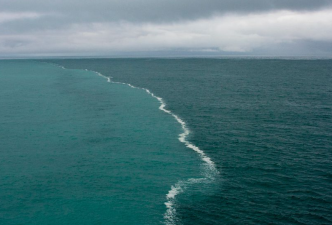
Furthermore, it is worth mentioning that because both Japan and Britain are located in mid-latitude island nations near the mainland, they are situated at the confluence of warm and cold currents. This unique geographical location endows their adjacent waters with world-renowned fishing grounds. Specifically, Japan's Hokkaido fishing grounds are located at the confluence of the Kuril Current and the Japan Current, while the UK's North Sea fishing grounds are situated at the confluence of the North Atlantic Current and the East Greenland Current. These maritime conditions have made both countries world-renowned fishing nations.
Common Characteristics of Economic Development
Economic Strategies and Transformation
Limited by their island size, both Japan and the UK have positioned their economic strategies around the acquisition of global resources and wealth. Before World War II, they primarily relied on their powerful navies for colonial plunder, but the war forced them to shift their development models. Today, they have formed unique export-oriented economies based on their respective historical foundations. The UK relies on its financial industry, leveraging its long-standing position as an international financial center; while Japan has earned global wealth through its strong manufacturing base. This has given both countries a pivotal position in the current global economic landscape.
Urban and Population Challenges
From a domestic economic perspective, both Japan and the UK exhibit a unique and highly dominant economic structure, with their capital city's economic zone being a key component. London, the capital of the United Kingdom, is located at the mouth of the Thames River in southeastern Britain. It is not only a major port of the UK but also a globally important financial center on par with New York. Its science, education, and fashion industries are renowned. Tokyo, located in Tokyo Bay in southeastern Honshu, Japan's largest island, is also a major port of Japan and is considered one of the world's four major cities, alongside New York, London, and Paris.
Due to their highly developed economies, both Japan and the UK currently face serious challenges in population growth, with Japan even experiencing negative population growth. This phenomenon has led to an aging population and other economic and social problems that are gradually emerging.
National Character and Culture
Character Traits and Cultural Background
Since ancient times, Japan has been an island nation with relatively limited interaction with other continental peoples, which has contributed to the introverted and conservative nature of the Japanese people. They are known for their humility and politeness, appearing courteous and mindful of propriety. Similarly, the British character has been influenced by Christian civilization, forming an important region of Christian civilization along with other parts of continental Europe.
The unique Gothic architectural style of London reflects the conservative and rigorous national character of the country. This characteristic has been preserved in both countries during their modernization processes and is reflected in their current constitutional monarchies. At the same time, this conservatism has also fostered a more pragmatic approach among the people of both nations, emphasizing industry, commerce, and scientific education. Britain, as the cradle of modern natural science and the Industrial Revolution, nurtured scientific giants such as Newton and Darwin and pioneered the invention of industrial machinery. Even today, British higher education remains among the world's best. Japan, on the other hand, is renowned worldwide for its high-quality cars and cameras, demonstrating strong industrial competitiveness. Today, Japan's robotics and semiconductor industries are also among the world's leading sectors.